Gambling is one example of digital life. We think it’s an example of many big issues around our life online. Our devices are everywhere. Some of us spend many hours of our day, many years of our lives ‘hooked up’. Some would say just hooked, of course!
While we can all point to the benefits of digital technology there are voices which raise alarms about some aspects. We all witness, for instance, being in company where people are constantly scanning phone messages rather than interacting in a healthy sociable way. If we are ill we may be referred to online support: what, if anything, do we lose from missing out on face to face contact? Have digital media become extensions of our nervous systems – or have our nervous systems become extensions of ‘the digital machinery’?
More specifically, are we exploited by clever commercial enticements? Do we buy stuff we don’t need. Do we give in to repeated nudges to gamble? Are we gradually becoming impatient of time itself (so that most websites will only be visited for a few seconds unless something really grabs us)? Why do we jump from one thing to the other, never settle, always restless? Remembering that modern television is digital and utilises many methods of obtaining viewers, is there something in our digital lives that keeps us seeking constant distraction. If so, distraction from what? Boredom perhaps. Why would we be bored? Emptiness, anxiety, depression, boredom are all markets for someone to ‘sell’ us something.
Addiction itself has been called a disease of time, a dis-ease, and uneasiness with time. In the short-lived pleasure zone of the ‘fix’, time drops away, along with anxiety, restlessness. Then the way to recover from the inevitable horrible feelings and consequences that follow, the only ‘cure’ is another fix. Time spent not engaged with addictive behaviour is spent thinking about, longing for the fix. It’s a cycle, it’s like being strapped to a wheel from which there seems no escape.
But extreme clinical addiction is only part of it. It may be the case that for many of us, a permanent state of restlessness or anxiety, inability to settle peacefully into the time of the moment, provides the fertile ground for marketing, profit-making.
Just a thought or two. But thinking’s the last thing we are used to doing. Quick! Let’s check our social media accounts, spend the afternoon internet ‘window shopping’. It’s here that for some the temptation to gamble is strongest, and the advertisements promise that everybody is a winner.
Humans have always been led astray, made bad choices, given in to temptations, been led by feelings, followed the crowd and so on. The idea that a human being is some sort of rational machine is ludicrous. The question is whether digital commercial (and political) enterprises have amplified our tendencies to go against our better judgment.
The Machine Zone website will continue to run quietly and in the background while we put our efforts into distributing our film, One Last Spin.
There are only two of us working voluntarily and even if we were super-robots able to cast wide nets of algorithms we couldn’t begin to develop beyond a whisper.
While most of our focus has been on electronic gambling during the past five years which is an important issue in its own right, we see online gambling as something which is an example of wider concerns in our digital world.
These include thinking about the enormous impact that digital media have on our societies and our individual identities. The early theorist Marshall McLuhan wrote in the 1960s of electronic media becoming ‘extensions of our nervous systems’. To some extent we swim in a digital medium, unaware of it as fish are unaware of water.
At an everyday level our attachment to digital devices determines how we live our lives, how we spend our time. Would we rather be constantly checking our ‘feeds’ at the dinner table, for instance, or taking part in human conversation? Do we think of Alexa as a sort of friend? Are we enticed by microtargeted advertising to behaviours that are not good for us? Do commercial interests employ digital techniques to hit our basic human vulnerabilities?
Are we, as ordinary people, equipped to use the ‘goods’ of digital technology while avoiding the ‘bads’ – and is this even possible now? There are huge questions that we can only ask about what it means to live in the digital world of 2022. We’ll ask some of them in the coming twelve months. We think we have asked some already in our previous posts, though of course nobody has time to read anything these days! We tend to be highly anxious to jump from one bit (or byte) of stimulation or entertainment to the next.
Returning to gambling as an example of some of the questions that may be raised, we’ll end with a quotation from a book we reviewed, Vicious Games by anthropology professor Rebecca Cassidy:
‘An experiment which began in the 1980s ((financial deregulation, neoliberalism)), to shift the burden of risk from the state to the citizen, has increased inequalities and changed the ways in which we imagine wealth is created and shared. Gambling has been at the heart of these shifts: in the City as it deregulated and embraced riskier, increasingly complex and opaque ways to make money, becoming less and less accountable as a result, and in government itself, which encouraged citizens to become self-sufficient individualists.’
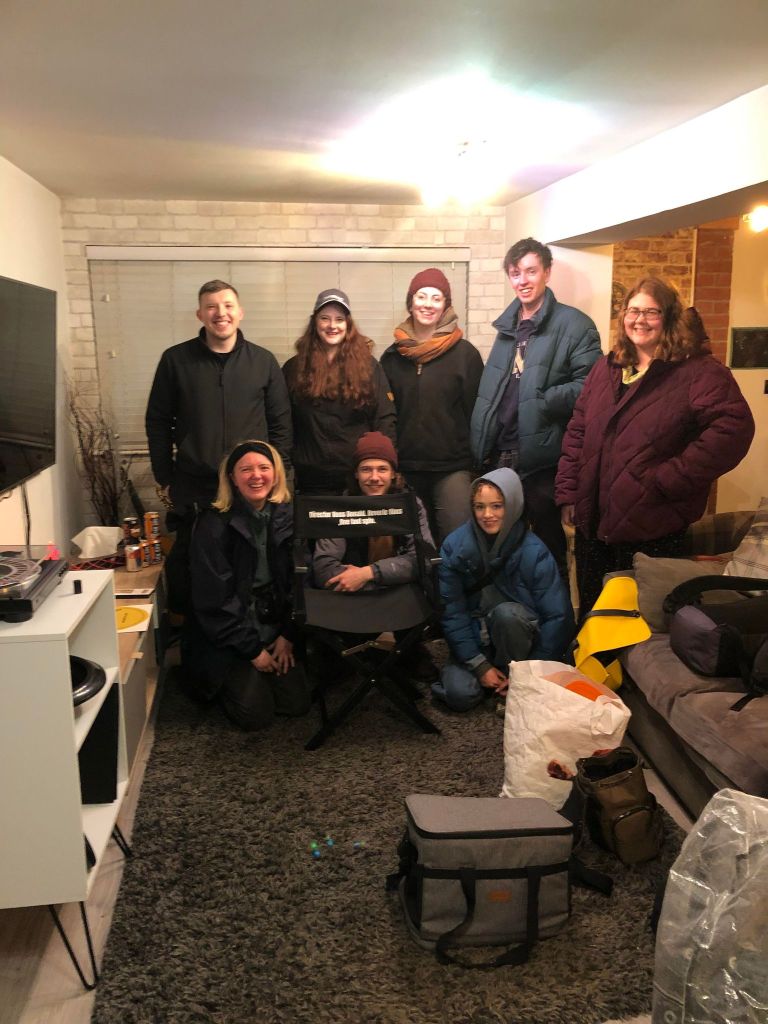
The last part of the film to be shot is Martin’s story. The crew gathered by night on 14 November, deep in the woods, powered by generators, to make what will be a very powerful scene.
All directed, of course, by Ross Donald. As an early Christmas present, Nartin bought him a chair!
By the way, on the chair is a vinyl LP complete with a ‘One Last Spin’ label. We hope to bring you news soon of a song being created to go along with our film.
The crew were fed and watered sufficiently to endure the harsh climate of Coatbridge. Just as well because they didn’t finish work until half an hour past midnight.
This drama sequence is indeed dark. It represents the part of Martin’s story when he considered taking his life.
From dark times people recover. Here’s a dazzling smile to testify to that. Martin with the actor who plays him, Brian Robson.
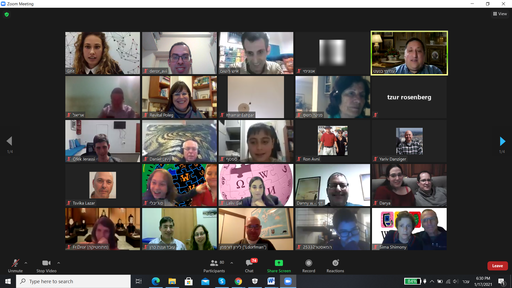
Many of us are not happy taking part in online meetings or online consulations with doctor or therapist. While accepting their necessity during the Covid lockdowns, and their usefulness in many cases, Zoom fatigue is yet another phrase to add to the dictionary of digital vocabulary.
In the longer term, we can agree that for some contexts such as business or other communications structured properly with a tight agenda, distance meetings have advantages: they save travel time, costs and are good for the environment. Formal meetings ideally would be strictly rational affairs, each participant following the long-established conventions of taking part. True, in many cases there are informal aspects of human involvement such as anger, irritation, sheer boredom. Sometime the ideal business structures of meetings fall apart as emotions take over.
Anyway, our concern here is with the suitability of online contact for mental and physical health treatment and support. Certainly while it was all that available it had much benefit. But there is an alarming tendency in some hot-eyed ‘digital health’ enthusiasts to promote it not as a necessary compromise but as the way forward to a bright new future. This vision can also include abolishing any form of contact at all. For instance, ‘smart’ devices can deliver and monitor our health and wellbeing. Little smiley faces can be programmed to pop up every half hour to remind us to ‘Be Happy!’.
Let’s consider the best case scenario in which you join an online one-to-one or group therapy/support session. How does this differ from being in the presence of real people?
Well, an obvious starting point is to agree that in a group Zoom session we lose an incredible amount of human contact and ways of taking part. In a group, for instance, we may see only head and shoulders with some participants maybe having disabled their video. Whose facial and other non-verbal reactions do we observe? Is anybody ‘looking’ at us? In a Zoom session can there ever be silence when nobody is talking? Are people who may be hesitant, shy, scared, confused, afraid to speak receiving encouragement and warm promoting from a facilitator or others?
It should be obvious that actual human engagement is of a much higher quality than murky two-dimensional representations. The vast majority of our actual communication occurs non-verbally. To achieve this quality, this communication, you need actual humans.
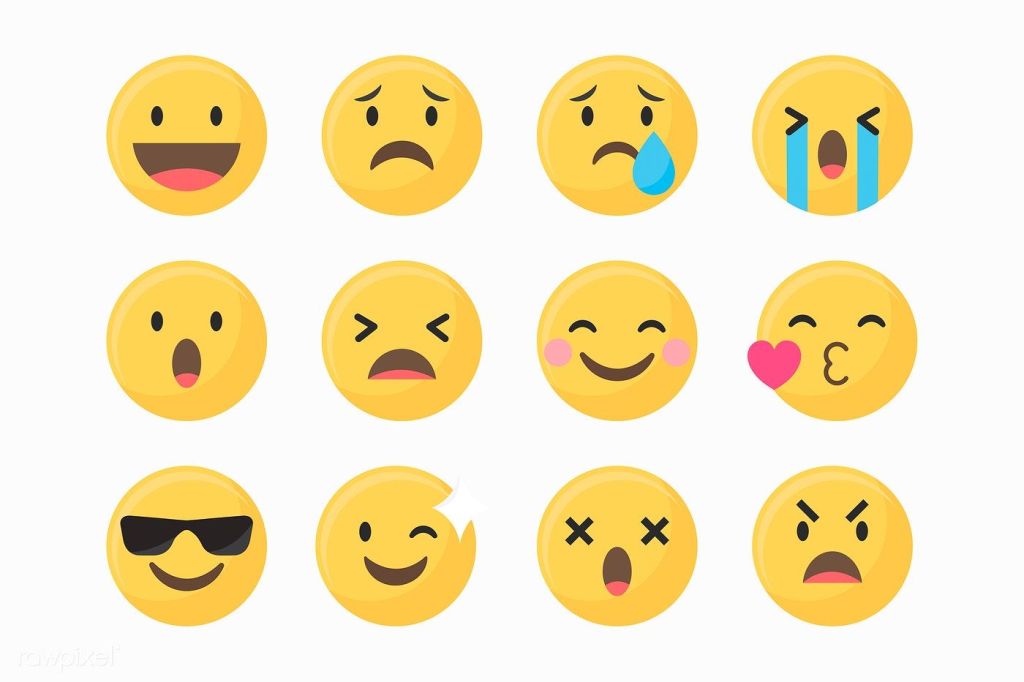
Unfortunately, the problem is related to a much deeper and growing issue. We are growing so used to reduce emotions to cartoon icons, to squeezing our identities into needle-thin, shrill social media interactions that we are in danger of losing our own and others’ incredible and unique richness.
To a very large extent this is all an evolution of a long history of turning ourselves and our feelings into things, quantities. How do you feel today on a scale of one to ten? What diagnostic box do you inhabit? What does your smartwatch show today about how many steps you’ve walked or what your oxygen saturation is in percentage?
Turning human beings into things, qualities into quantities, human misery into graphs and data, reducing the unique experienced distress of someone to a neat diagnosis. All this fits perfectly in a driven. 24/7 world of accelerated time where there is never time enough, never a place to rest, and for so many people never the chance of the most important things in life: slow, intimate personal relationships and the unlimited power of genuinely human interaction.
As said, the turning of our unique individuality into a thing rather than a person goes back a long way and is being hugely amplified by the impact of digital technology on culture. To end, here’s a poem from almost a hundred years ago by W.H. Auden:
The Unknown Citizen
(To JS/07 M 378 This Marble Monument Is Erected by the State)
He was found by the Bureau of Statistics to be One against whom there was no official complaint, And all the reports on his conduct agree That, in the modern sense of an old-fashioned word, he was a saint, For in everything he did he served the Greater Community. Except for the War till the day he retired He worked in a factory and never got fired, But satisfied his employers, Fudge Motors Inc. Yet he wasn’t a scab or odd in his views, For his Union reports that he paid his dues, (Our report on his Union shows it was sound) And our Social Psychology workers found That he was popular with his mates and liked a drink. The Press are convinced that he bought a paper every day And that his reactions to advertisements were normal in every way. Policies taken out in his name prove that he was fully insured, And his Health-card shows he was once in hospital but left it cured. Both Producers Research and High-Grade Living declare He was fully sensible to the advantages of the Instalment Plan And had everything necessary to the Modern Man, A phonograph, a radio, a car and a frigidaire. Our researchers into Public Opinion are content That he held the proper opinions for the time of year; When there was peace, he was for peace: when there was war, he went. He was married and added five children to the population, Which our Eugenist says was the right number for a parent of his generation. And our teachers report that he never interfered with their education. Was he free? Was he happy? The question is absurd: Had anything been wrong, we should certainly have heard.
Hello! Ages since we posted on The Machine Zone. We have been very busy with two projects under our banner. One is gamblingwatchscotland.org.uk which is a developing site looking at gambling in Scotland and beyond.
The other is our film, ‘One Last Spin’ which should be finished in November and premiered in December. The interviews dor the film were completed a long time ago but lockdown brought further work to a halt. We’re back shooting again, this time drama sequences to complement the interviews. Check onelastspin.vision for latest and some screenshots.
The Machine Zone has been running for five years come next February. It’s been very much a labour of passion and determination, and involved thousands of hours of voluntary work. Martin and Adrian have had to put in a lot of money to keep it going. This year we have a new director, Chris Lee who’s based in Edinburgh and runs a peer support service at chatter.org.
We received a £3,000 award from Greater Glasgow and Clyde NHS to deliver anti-stigma work, The money has helped build the website and some of it towards the film (which is set to cost in the many thousands for production), and rolling future costs for screening the film at community events initially in Glasgow through 2022.
The next year will continue to be occupied by these projects. However, where time allows we are keen to get going on exploring the digital environment generally, beginning with that slippery term ‘digital health’. In some quarters everything digital, new and shiny sends people weak at the knees with adoration. We’re not so sure. Our work on gambling harms, for instance, shows how quickly digital technologies have been taken up to cause tremendous harms to many.
We’ll look at what may be meant by ‘digital health’ (which is a very confused, and confusing, area) and try to place it in a broader context of the digital environment as a whole. Every new technology causes tremendous social upheaval, the good and the bad. It’s easier to see this looking back to the advent of machinery at the start of the Industrial Revolution, motor transport, mass media, and so on. Not so easy to see how each of us is affected by the digital revolution. Certainly we can identify obvious things such as new jobs and the internet. But there does seem a very strong case for considering whether our deep psyches are affected, our relationships, our well being.
The Gambling Watch Scotland website is now partially ‘live’. Full of life but still a baby. You can see a landing page which outlines the project and its content, and there’s a Support page. Both of these pages are temporary.
As we work on the website it’s sometimes overwhelming to discover how many aspects to talk about gambling damage there are. We are looking on the one hand at wordy reports and regulations from ‘them up there’ while keeping a central focus on individuals and their communities. We’re maintaining links with big organisations working on the human costs of gambling, while energised by the growing grassroots initiatives and the voices of Experts by Experience. It’s the grassroots work we’ll be highlighting and celebrating.
It’s a very small project in the scale of things. Though we look closely at the broad national contexts, we zoom in on Scotland, and particulaly Greater Glasgow because it’s in this city we will concentrate our attention to involve community citizen involvement.
We hope you can spare a few minutes to look over the landing page. We’d be delighted if you follow us on twitter or by email. Any ideas, articles videos you may wish to share, well. we’d be gobsmacked.
Just to confuse everybody we have renamed our anti-stigma project to Gambling Watch Scotland
For various reasons we are going with the new name and logo. Everything about the project remains the same, and you can read a description here.
We shall be delivering our website in March. However, while we hope this will be a valuable and lasting resource which can be updated and invite contributions, our intention remains to deliver our work in community settings as and when COVID restrictions allow.
We’d love to hear from people for whom stigma brought shame and a reluctance to come forward to share their problems or seek support. We’d especially lke to hear from people suffering various degrees of social stigma already, before the stigma of gambling was added. These may include women, people from minority ethnicities, religious affiliates, refugees, people with high status jobs or positions in societies.
“As an addict, society tells you that you’re bad, somehow evil, a wrong ’un and you end up believing it.”
We welcome any level of contribution from a few words to an article. If you feel willing to share your experiences of how stigma impacted, or is impacting, upon your wellbeing and recovery from harms please drop us a line at:
themachinezone@planetmail.net or DM us at twiiter, @themachinezone.
We’ll stick exactly to your wishes for how your contributions may be used.
Stigma, shame, guilt can be a heavy load to bear leading to a horrible sense of isolation with nowhere to turn.
We’re working on a project, to be delivered online by March 2021, which aims to reduce the stigma around gambling by awareness-raising, provide ideas for individuals to cope with stigma, and share lived experience of gambling stigma. How bad was it? Did it stop you – or does it stop you – from reaching for support? Did you find ways to handle internalised stigma and the deep sense of shame or guilt that went with it? Was stigma particularly worse for you because, for instance, you are a woman or member of a community which has strong condemnation of addiction?
We’d love to hear from you. A short piece of writing maybe, using a pen name if you like. Or a long piece. Would you be prepared to take part in a Zoom session to discuss various aspects of gambling stigma? In all cases we will respect requests for strict anonymity.
Sharing your story will help others immediately to see that they are not at all alone in their feelings of isolation and any shame or guilt, that these are further intense bad feelings that come with addiction. Any ways you found to cope with stigma will also help people greatly.
If you can take part please send us your thoughts. As said, short or long – and sometime one or two sentences can be powerful. Please indicate whether you’d be prepared to consider taking part in a Zoom event.
We’re also very keen to hear from organisations working in the gambling field which have experience of how damaging stigma is to people they work with.
Stigma adds massively to the suffering of folk who have mental health issues. It may prevent their seeking support, leave them feeling isolated and ashamed that they have a ‘weakness’. There are even greater stigmas around addictions, and gambling disorders are known as the ‘invisible addiction’ – not only because you can’t see a substance involved, but also because there is very little understanding and awareness in the population. This includes health and other care professionals and policy makers. The consequence is that there is a lack of support services.
Across the mental health field there have been vibrant, powerful and dynamic anti-stigma campaigns and initiatives which have helped reduce stigma although there is still a long way to go.
The Machine Zone is developing a project to address stigma and gambling disorders. As with most anti-stigma initiatives we aim primarily to raise awareness and knowledge, and dispel myths. We shall also focus upon stigma itself – what it is, its damaging effects, and how we can cope with it.Initially, the idea was to take this into community settings, including prisons, with the aim of raising awareness, discussing issues, signposting support and encouraging citizen involvement. With Covid restrictions, we will now be presenting the project online, hoping in the future to work in communities. The project will be delivered in March 2021.
The project will include a film about lived experience and there will be sections about support, community work, stigma, articles for professionals and media, links and networks, partnership working, and a forum for discussion. We’ll refer to the many sections of the population bearing multiple stigmas and difficulties such as poverty, exclusion, social discrimination, poor health, inequality. We believe that one of the best ways to challenge stigma is to raise awareness and hear the voices of those affected.
This work contributes to NHS Greater Glasgow and Clyde’s Healthy Minds anti-stigma initiatives, and several Third Sector mental health and addiction anti-stigma projects.
We’d love to include as many voices as possible. Please go here to read an invitation to contribute your own story.
The Chief Executive of the Betting and Gaming Council, Michael Dugher, wrote in PoliticsHome on 9th January 2021:
When the Government announced before Christmas that it was kicking off the Review of Gambling, they did so with a “call for evidence” and they rightly said their determination to drive big changes will be “evidence-led”. This is something I strongly support.
Ministers made it clear that the percentage of problem gamblers in Britain stands at approximately 0.5 per cent of the adult population – comparatively low by many international standards – and that “this rate has remained broadly steady around or below one per cent for the past 20 years”.
The headline of his article calls for facts not fiction. He cites as facts that there is an ‘anti-gambling lobby’ who are ‘prohibitionists’ intent upon promoting ‘hysteria’ around gambling.
Facts are tricky things. So are statistics, data, ‘evidence’. Regarding the latter we published an article which raised some big questions about evidence during the campaigns to have the stake on Fixed Odds Betting Terminals reduced from £100 to £2. What was then the industry body, the Association of British Bookmakers, demanded ‘evidence that the machines were harmful with £100 stakes.
Evidence is not an innocent word. You can find or not find evidence for anything depending upon your perspectives and agenda. The big government and other machines for gathering evidence use models of gathering data. Interestingly, perhaps an admission of a failure of previous figures and ‘facts’:
This was in response to a recent House of Lords committee report on the gambling industry. Further, :
It would seem that neither the government nor the Gambling Commission have faith in the widely promoted ‘fact’ that ‘problem gamblers’ represent ‘only’ 0.7% of the population. A 2020 YouGov survey suggested that the figure is 2.7%. Quite a difference. When is a fact not a fact?
Aside, for a moment. The prevalence of the serious mental health condition called bipolar is estimated to be 2%. Should we say ONLY 2%? Not worth bothering about. Another fact to bear in mind in this aside is that with mental health diagnoses, three pyschiatrists may give three different diagnoses. And the diagnosing of mental health conditions varies between nations and different cultures. Further, it is clear that different sections of populations are more likely to receive particular diagnoses.
Returning to gambling harms:
So, even with current official figures, young people seem to represent a higher prevalence of harms than the general population. The young people of today are the adults of tomorrow and perhaps youth behaviour suggests worrying future trends in the near future.
While there are worrying indicators of increased exposure to gambling harms for women, the majority of people who face harm are men. Whole population figures do not remotely reflect the scale of the harms because they take an average which includes a gendered majority who face no harms.
Individual populations such as young people (which really needs breaking down to gender, ethnicity, social class, mental health conditions, educational attainment, religion, indices of poverty and deprivation) provide unuseful statistics as they don’t focus upon groupings within the individual population.
There are particular populations which require specific attention to them such as ethnic minorities, religious affiliates, LGBQT citizens. ‘Official’ attention to essential factors such as health, mental health especially, exclusion, exploitation, poverty, inequality and discrimination tends to be weakened by an institutionalised ‘whole population’ approach, the whole population being some vague collections of ‘normalised’ people. Of course, and it can’t be emphasised too much, that within ‘official’ institutions much progress is being made to remove this attentional blindness. What is most exciting is the ‘bottom up’ work of campaigning by minority groups, so often against the odds.
That report by the way shows that 4% of those surveyed were in prison because of gambling. Certainly, we have to move well beyond rather empty claims that the prevalence of gambling ‘disordered’ individuals in ‘the population’ is 0.5% (a figure which in any case is almost certainly a significant underestimate even using the outdated models previously used by the Gambling Commission and others). There are man, many populations within ‘the population’, and many individuals in each.
Stigma and the Invisible ‘Addiction’
We are currently working on a project around stigma and gambling. Stigma is the cause of much of the extra anguish to add to the pains of suffering from gambling harm. It leads to shame, guilt, and a fear of admitting to problems or seeking help.
When your GP routinely asks you about your drinking habits you may lie, give a lower or much lower figure than your actual intake. You don’t want a lecture perhaps, but more than this you are ashamed about how your drinking is ‘out of control’. Ashamed, because only weak people are not in control of their behaviours. Ashamed because you are now outside the norms of decent society. Ashamed because, whatever the success of anti-stigma campaigns, you carry within you, have learned, that ‘addicts’ are bad, worthless, irresponsible. The felt stigma will vary between individuals but some groups will feel it more. A Muslim will have violated their religious and community codes for instance. A woman is likely to feel strongly the stigmas against female ‘drunks’ and ‘alkies’ and ‘lushes’: women are ‘supposed to be@ good mothers, home makers, protectors of children.
You can do all the high-poered, expensive, expert data gathering, analysis and statistical interpretation you like. You won’t be able to include figures for the unknown population of people suffering badly but who feel impelled to keep it to themselves.
Gambling Careers
There has been a welcome move towards valuing the voices of ‘Experts by Experience’ – in health generally and mental health specifically. (It is still not obvious to too many by the way that suffering from gambling harms is a mental health condition. We have a long way to go before health institutions not only stop talking about ‘mental health and addiction services’ but also incorporate a clear understanding into their core values and outlooks). Promisingly,Experts by Experience are involved in a dynamic involvement with health services, professionals from many fields, politics, shaping policy, media. Many individuals go on to find work in the ‘recovery’ field. Others volunteers support groups and peer to peer mentorships. Many are involved with campaigning – and some say that such involvement helps their own recovery.
There is another crucial point to focusing upon the individual. As we saw above, there are many different populations of gamblers, and no such thing as a blank-faced ‘problem gambler’ occupying a ghetto called ‘problem gamblers’. At individual level, the need to think of the whole-person should be obvious. Sensitivity to a woman’s experiences is useful with caution; but much greater sensitivity to that particular human woman is more important. We have to take away the boxes we put people into, the labels we use, the blinkered views our pre-judgments may entail. We have to be sensitive to life story, life situation, health, co-occurring harms such as substance dependence syndromes. What we can never do is think of AN addict. To label someone is to dehumanise them. To label someobody with the word ‘addict’ is horrible. It’s a word loaded with negative, highly stigmatising violence. If we have to use the word at all – as we will do as long as there are ‘mental health and addiction services’ – we should strike it through. ADDICT.
During an individual’s gambling career there will be enormous variations between people. Some may gamble only on certain occasions but do so in a way in which they can severely harm themselves and others. Some may go weeks, months, years without gambling and then ‘relapse’. Others gamble every day and lose every day. Some turn to crime to fund their gambling. A person who has rarely gambled may bet on a certainty one night and los etheir home. An old person may become ill with cold and malnutrition because she spends a good part of her meagre pension on scratchcards. Faced with trauma, redundancy, depression or just boredom someone may turn to gambling – for the experience of gambling is itself an escape into a sealed-off world where anxieties cease. A person with bipolar, in a manic or hypomanic phase may gamble recklessly. (It’s estimated that bipolar individuals have a 50% greater risk of gambling harms than the general population). A gang of of mates drinking and betting fiercely on their mobiles as a football game proceeds on television may introduce to gambling the new member of the group who wants to ‘fit in’. All the kids in school are gambling, your parents are gambling and you want to be grownup.
There is no typical career. But it should be said that a relatively casual ‘low risk’ gambler can hit the buffers at any time when conditions are there. Glasgow University Gambling Research Group is currently engaged in a three years project talking to many individuals about their ‘gambling careers’. The study does make use of the term ‘problem gamblers’ which is a phrase that carries with it some unfortunate negative connotations; however, it understands that there are very many gambling behaviours and harms, and degrees of harm, the crucial importance of individual life factors, so implicitly undermines any concept of a typical ‘problem gambler’:
Rather than viewing problem gamblers as a relatively small and distinct group, the study will look at problematic behaviour as a particular phase that can affect many more individuals at some point(s) in a gambling career, and will examine the way that behaviour waxes and wanes among this larger group. It will focus on key moments and processes of change such as, for example, how people begin gambling, points when playing increases or decreases, when individuals realise they have a problem and decide to seek help – or not – and the circumstances that surround this.
Experiences of treatment: perceptions of its benefits, as well as relapses and reasons for leaving it, will also be explored. Given that the vast majority of problem gamblers never seek treatment, the research will focus in particular on the phase of ‘natural recovery’ in which problematic behaviour is resolved without formal intervention, and will explore shifts in social, demographic and personal circumstances that are associated with it.
This article has tried:
to demonstrate that the government and the Gambling Commission are seeking new ways to gather a better and more accurate view of the prevalence of gambling harms.
to suggest that calls for ‘evidence’ and ‘facts’ are based on innocent and naive misunderstandings, or else are being used as rhetoric against the ‘hysteria’ of ‘gambling prohibitionists’.
to sketch out some of the crucial differences between population studies versus the experiences of individuals.
to outline some of the issues around the term ‘evidence’ and show that it is by no means a simple ‘innocent’ word.










 The Machine Zone